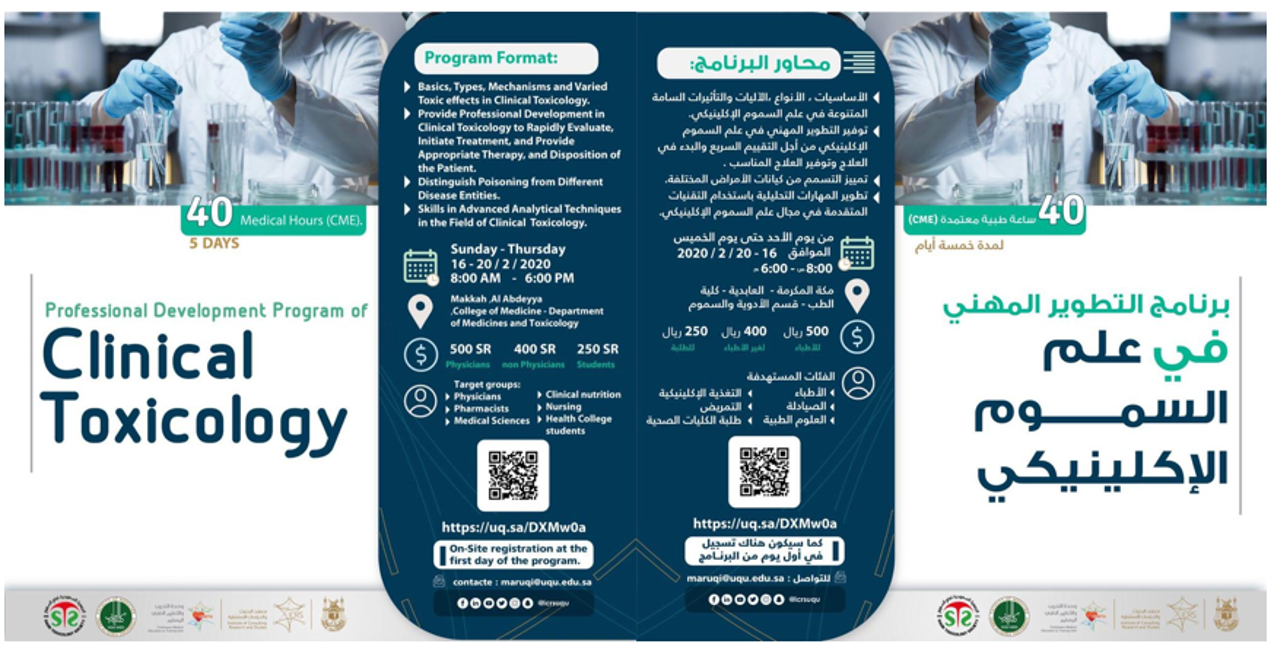
The Professional Development Program in Clinical Toxicology was organized by the Saudi Toxicology Society, in collaboration with Umm Al-Qura University, College of Medicine, Department of Pharmacology and Toxicology, and other supporting partners. The program was held in Makkah, Al-Abdeyah, College of Medicine, from 16–20 February 2020, running daily from 08:00 AM to 06:00 PM, over five days, and was accredited for 40 CME hours. The program focused on strengthening professional knowledge and practical skills in clinical toxicology, including the basics, types, mechanisms, and varied toxic effects in clinical toxicology. It also aimed to provide professional development for the rapid evaluation, initial treatment, and appropriate therapy and disposition of poisoned patients. The program covered how to distinguish poisoning from different disease entities and highlighted advanced analytical techniques used in clinical toxicology. The target audience included physicians, pharmacists, medical sciences professionals, clinical nutrition specialists, nursing staff, and health college students, with the overall aim of improving clinical competence in the diagnosis and management of poisoning cases.
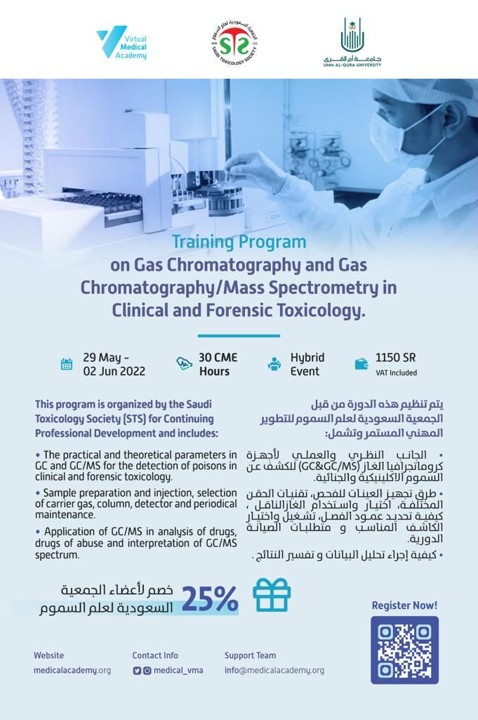
The Training Program on Gas Chromatography and Gas Chromatography/Mass Spectrometry in Clinical and Forensic Toxicology was organized by the Saudi Toxicology Society (STS) for continuing professional development, in collaboration with Umm Al-Qura University and the Virtual Medical Academy. The program was held from 29 May to 2 June 2022 as a hybrid event and was accredited for 30 CME hours. The main focus of the program was to provide theoretical and practical training on the use of GC and GC/MS techniques in the detection and analysis of poisons within clinical and forensic toxicology. The program covered key areas such as sample preparation and injection, selection of carrier gas and column, detector operation, periodic maintenance, and the application of GC/MS in the analysis of drugs and drugs of abuse, including interpretation of GC/MS spectra. The course aimed to enhance participants’ analytical skills and strengthen their competence in toxicological testing, forensic investigation, and laboratory-based diagnosis of poisoning cases.
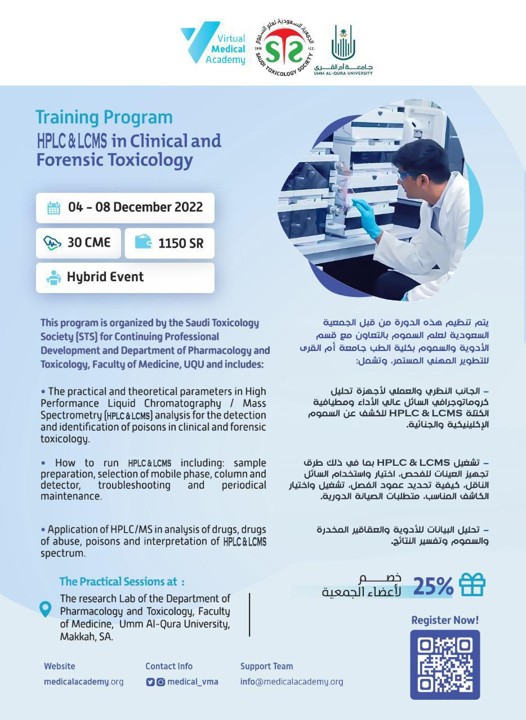
The Training Program on HPLC and LC-MS in Clinical and Forensic Toxicology was organized by the Saudi Toxicology Society (STS) for continuing professional development, in collaboration with the Department of Pharmacology and Toxicology, Faculty of Medicine, Umm Al-Qura University, and the Virtual Medical Academy. The program was held from 4–8 December 2022 as a hybrid event, with practical sessions conducted at the Research Lab of the Department of Pharmacology and Toxicology, Faculty of Medicine, Umm Al-Qura University, Makkah, Saudi Arabia. It was accredited for 30 CME hours. The program focused on the theoretical and practical principles of High-Performance Liquid Chromatography (HPLC) and Liquid Chromatography–Mass Spectrometry (LC-MS) for the detection and identification of poisons in clinical and forensic toxicology. Key topics included sample preparation, mobile phase selection, column and detector use, troubleshooting, periodic maintenance, and the application of HPLC/MS in the analysis of drugs, drugs of abuse, and poisons, including interpretation of HPLC and LC-MS spectra. The program aimed to strengthen participants’ laboratory and analytical skills and enhance their competence in toxicological testing, forensic analysis, and the accurate diagnosis of poisoning cases.
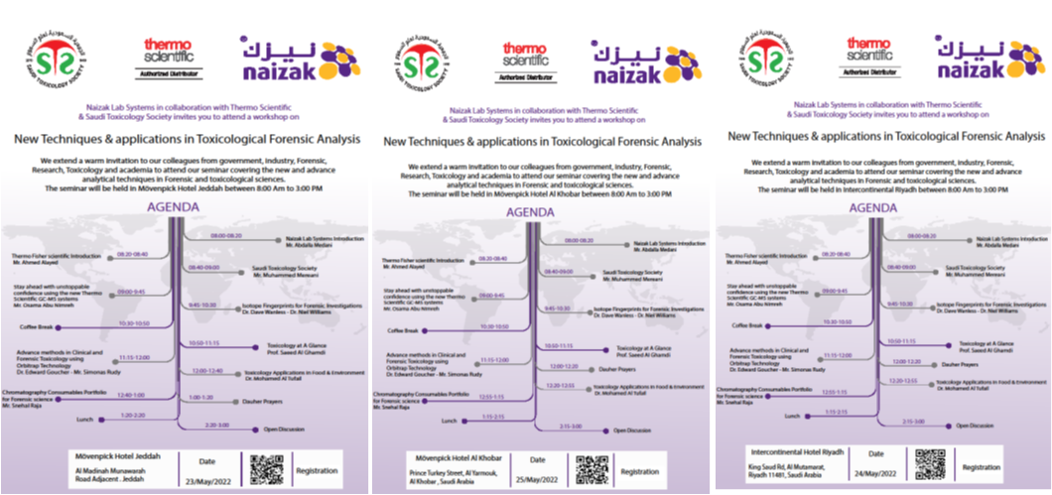
The Scientific Program on New Techniques and Applications in Toxicological Forensic Analysis was organized by Naizak Lab Systems in collaboration with Thermo Scientific and the Saudi Toxicology Society (STS). The workshop was delivered as a seminar series in three Saudi cities: Jeddah on 23 May 2022 at Mövenpick Hotel Jeddah, Al Khobar on 25 May 2022 at Mövenpick Hotel Al Khobar, and Riyadh on 24 May 2022 at InterContinental Hotel Riyadh. Each workshop was held from 08:00 AM to 03:00 PM.
The program focused on recent advances and practical applications in forensic and toxicological analysis, particularly the use of modern analytical technologies in clinical, forensic, food, and environmental toxicology. The agenda included topics such as advances in clinical and forensic toxicology using Orbitrap technology, chromatographic consumables for forensic science, fingerprinting for forensic investigations, toxicology at a glance, and toxicological applications in food and environmental analysis. The workshop targeted professionals from governmental sectors, industry, forensic laboratories, research institutions, toxicology, and academia, aiming to update participants on current analytical techniques and strengthen their practical knowledge in toxicological forensic investigations.