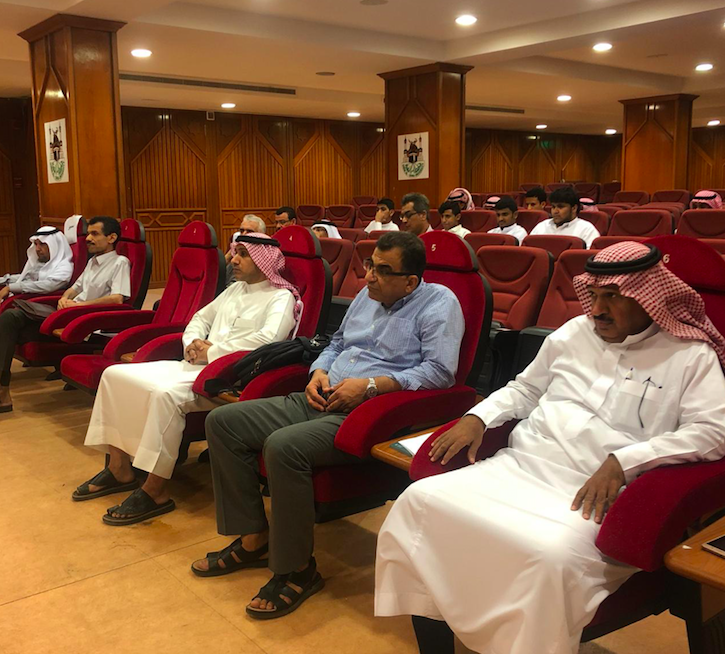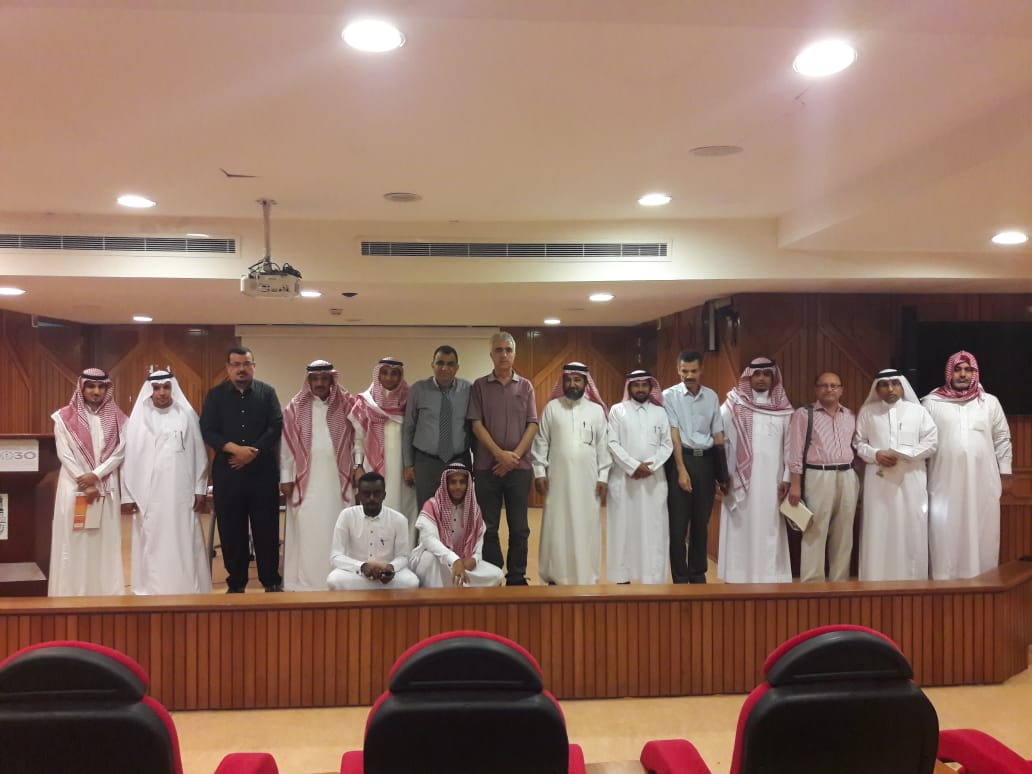
The Department of Arabic Language organized a scientific seminar entitled: 'The Linguistic Lesson: Philology and Linguistics' at the theater of Al-Qunfudhah University College. During this seminar, two doctors gave lectures. Dr. Ali Al-Shahri lectured on 'Philology: Its History and Functions', and Prof. Nuaman Buqrah lectured on 'Linguistics: Its Schools and Functions'.
The Academic Committee was chaired by Prof. Lutfi Dabish from the Department of Arabic Language. At the opening of the session, Prof. Dabish highlighted the importance of the topic on the agenda, due to its connection with the teaching of the Arabic language at the university. He pointed out the need for the learners to simultaneously acquire the sciences of "philology" and "linguistics", as both of them represent a cognitive mechanism that aims at representing the Arabic language in terms of its establishment and development, and the treatment of its ancient and contemporary issues.
The first lecturer, Prof. Ali Al-Shahri, Head of the Department of Arabic Language, reviewed the topic of "Philology", clarifying the importance of this field of knowledge in addressing the problems of the Arabic language, and understanding it in the light of its different historical stages. Philology as a science endeavors to reveal the secrets of the Arabic language, and learn the secrets of its development. It comprises the studies that are concerned with the origin of languages, semantics, and the evolution of syntax. It is a mechanism of knowledge concerned with evaluating and comparing languages, as well as explaining their old texts.
He explained that the aim of studying "philology" or "linguistics" is to teach the Arabic language at the university in the finest form. He stressed that the colloquial language poses no threat to the Arabic language. However, it is feared that the colloquial language may gradually infiltrate and replace the classical Arabic language.
The second lecturer, Prof. Nuaman Buqrah from the Department of Arabic Language, divided his lecture into three parts: first, the history of linguistics; second, the methods of linguistic analysis; and third, the use of linguistics in language and literary studies.
He then discussed the new and promising areas of linguistics, namely corpus linguistics, computational linguistics, and forensic linguistics. He explained that linguistics does not differentiate between languages, as there is no preference for one language over another, and no fixed standards in all schools of linguistic research.
After the two lectures, the Chairman of the Committee opened the floor for discussion. Many questions were put forward by the audience, and the two lecturers readily interacted with them by providing answers and analyses.
The session was concluded with a presentation on the program of the seminars of the Department of Arabic Language in the coming weeks until the end of the current semester.